Shatabdi Express pelted with stones in UP, RSS chief Bhagwat onboard
Police are examining CCTV footage after stones were allegedly thrown at the Shatabdi Express carrying RSS chief Mohan Bhagwat from Kanpur to Delhi.
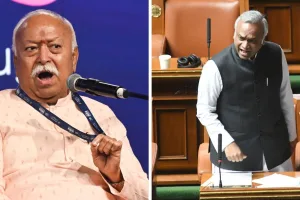
RSS chief Mohan Bhagwat rejected demands for registration and transparency, prompting Karnataka minister Priyank Kharge to reiterate that influential organisations must remain accountable under the law.




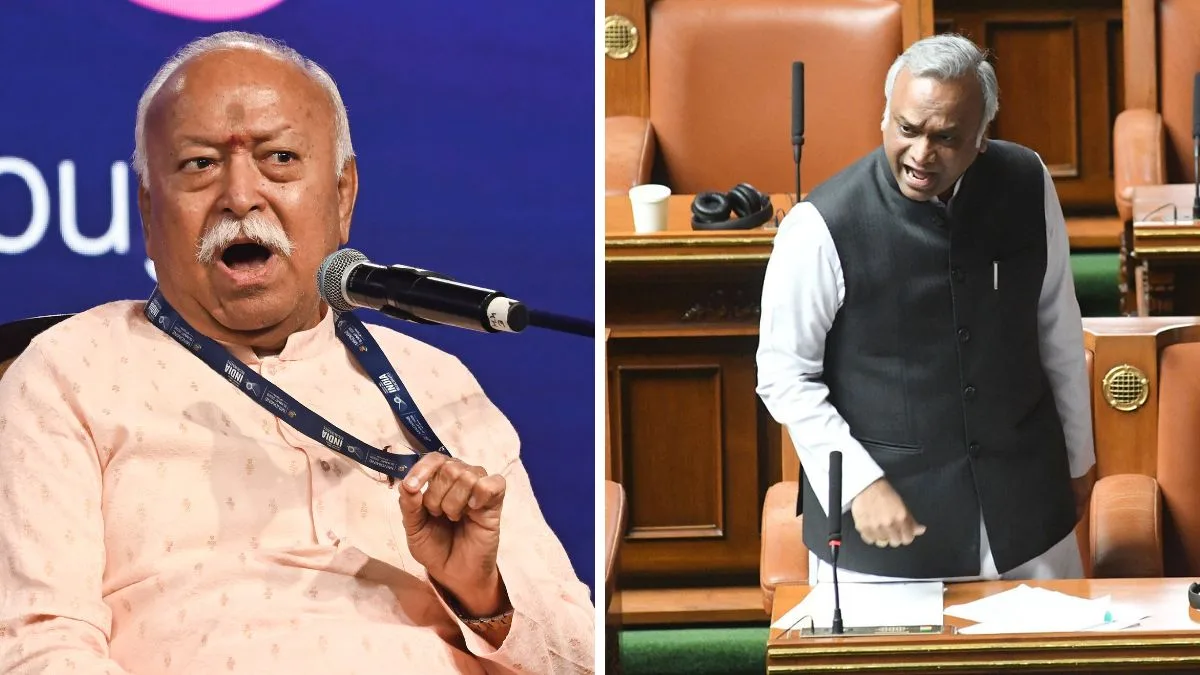
RSS chief Mohan Bhagwat dismissed demands for registration of the organisation, while Karnataka minister Priyank Kharge renewed calls for transparency and accountability. | IANS
The debate over the Rashtriya Swayamsevak Sangh’s legal status has intensified, with RSS chief Mohan Bhagwat rejecting calls for registration and transparency and Karnataka Home Minister Priyank Kharge responding that no organisation in a constitutional democracy can claim immunity from public scrutiny.
Speaking at an event in Kerala’s Thrissur, Bhagwat dismissed Kharge’s demand that the RSS register itself and disclose greater details about its functioning. He described the criticism as political in nature and said the organisation had faced similar attacks for decades.
Advertisement
According to Bhagwat, the RSS functions openly and does not operate in secrecy.
Advertisement
“I don’t need to respond. There are so many unregistered things going on, and we are not secretive. We are working in the open. We are calling people and telling them about the Sangh. This is politics, and all these gimmicks are being tried. We are used to it. After 10-15 years of the Sangh’s existence, we had to face all these things. We are used to it,” Bhagwat said.
The RSS chief argued that several aspects of public life are not formally registered and questioned why the organisation was being singled out.
“Hindu Dharma is not registered. Many things are not registered. The government banned us twice, and those bans were lifted once by court order and again through Satyagraha. So the government knows the RSS exists. If they banned the RSS, it means they recognised its existence,” Bhagwat said.
He also rejected suggestions that the organisation works behind closed doors.
“Our karyakartas live in all localities. People see them every day. Our shakhas are held in open grounds. People see them daily. We have public programmes,” he said.
Bhagwat further claimed that attempts to question the RSS were aimed at creating suspicion about the organisation among the public.
“They want, on one hand, to hamper the Sangh’s work and, on the other, create doubts in the minds of people. But that is no longer possible because people know us,” he said.
Later, Priyank Kharge reiterated his demand for answers from the RSS and clarified that a video of Bhagwat circulating on social media was recorded before his open letter was made public.
“A video of @DrMohanBhagwat ji is being widely circulated as a response to my letter is false. I dispatched my letter and put it up on social media on June 15, while this interaction by the RSS Chief was on June 13/14,” Kharge posted on X.
A video of @DrMohanBhagwat ji is being widely circulated as a response to my letter is false.
I dispatched my letter and put it up on social media on June 15, while this interaction by the RSS Chief was on June 13/14.
Let me set the record straight.
The RSS has every right to… pic.twitter.com/HLCvgL4bAY
— Priyank Kharge / ಪ್ರಿಯಾಂಕ್ ಖರ್ಗೆ (@PriyankKharge) June 15, 2026
The Karnataka minister said the RSS was free to function as a cultural organisation but questioned whether an entity with extensive influence over public life should remain outside the framework of public accountability.
“The RSS has every right to be a cultural organisation. That is their choice. But it cannot simultaneously exercise enormous social and political influence while repeatedly insisting that it has no political agenda and therefore owes no public accountability,” he said.
Kharge also pointed to what he described as the scale of the RSS network, saying the public had a right to know whether the organisation complies with the same legal standards expected of others.
The latest exchange stems from an open letter written by Kharge to Bhagwat, in which he sought clarification on the RSS’s legal status, financial transparency and constitutional accountability as the organisation approaches its centenary year.
Kharge argued that an organisation claiming more than 60,000 shakhas and crores of swayamsevaks in India and abroad occupies a significant position in public life and should therefore meet the highest standards of transparency.
Responding to Bhagwat’s comparison between the RSS and Hindu Dharma, Kharge said the analogy was misplaced.
“The argument that a religion cannot be registered and therefore the RSS need not be registered is both flawed and absurd,” he said.
He also took exception to Bhagwat’s reported view that the RSS was under no obligation to answer questions.
“In a constitutional democracy, no institution, however old or influential, enjoys that privilege,” Kharge said.
The minister maintained that the questions raised in his letter were legal and constitutional in nature and should be answered by the RSS leadership itself.
“I have raised some legal issues, and I have asked some Constitutional questions. Let Mr Mohan Bhagwat answer, let the RSS answer. Why should I answer?” he said.
Advertisement